Measuring the ROI of your trade show presence: Essential KPIs for your booth
SOMMAIRE
Temps de lecture :
Participating in a trade show (renting space, designing a booth, travel expenses) represents a significant portion of the annual marketing budget.
However, many companies still fly by the seat of their pants once the event is over, content with a general impression such as “the show was dynamic.”
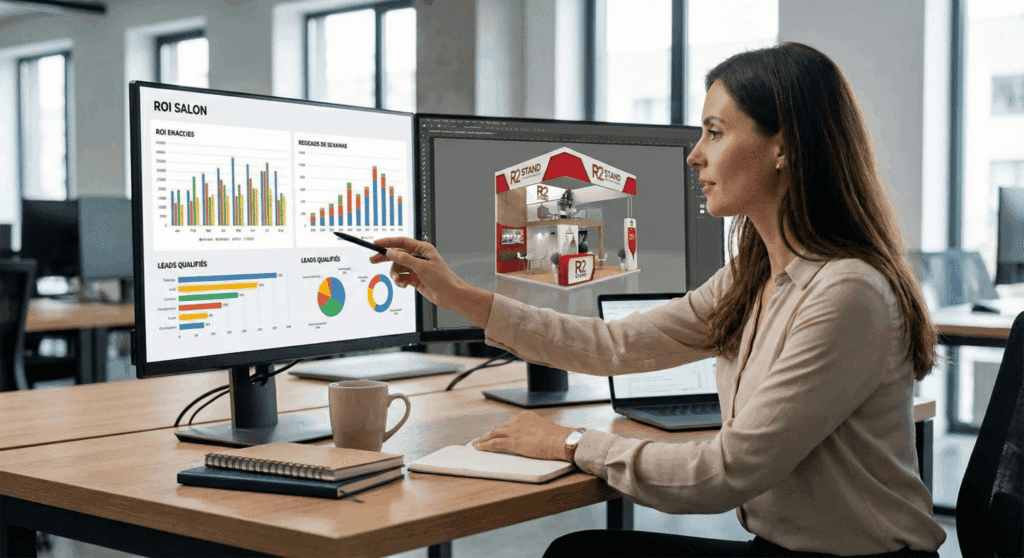
Today, measuring the ROI of your trade show presence is essential. To justify this investment and optimize your future participation, you need to rely on hard data: KPIs (Key Performance Indicators).
Here is our guide to defining, tracking, and analyzing your booth’s KPIs.
Why is it crucial to calculate the profitability of your booth?
Post-trade show evaluation is not just about reviewing the financial results.
Analyzing the impact of your event allows you to:
Justify the budget to your management for the following year.
Identify the strengths and weaknesses of your exhibition strategy (was the booth visible enough? Was the team large enough?).
Calculate the customer acquisition cost (CAC) specific to the event channel.
Adjust your approach for the next trade show by modifying the layout or activities at the booth.
Quantitative KPIs: measuring the commercial impact of your trade show presence
These are numerical, objective, and direct indicators. They form the basis for calculating your return on investment.
Lead volume and Cost Per Lead (CPL)
This is the ultimate trade show attendance KPI. How many usable contacts did you collect using your interactive kiosks, badge readers, or tablets? To take it a step further, calculate your CPL (Cost Per Lead):
CPL = Total trade show budget / Number of leads collected
If your total budget is €20,000 and you have collected 400 leads, your CPL is €50. This figure allows you to compare the effectiveness of the trade show with your digital campaigns (Google Ads, LinkedIn, etc.).
To maximize the number of leads, it is important to implement attractive strategies. For example, you can:
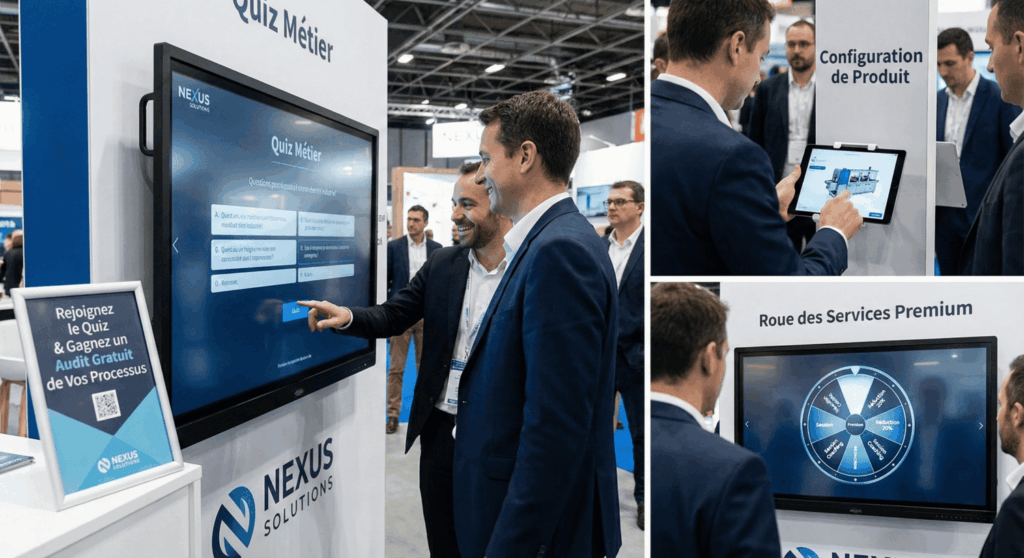
Organize interactive demonstrations: Attract visitors’ attention by presenting your products or services in a dynamic way.
Offer exclusive deals: Encourage visitors to leave their contact details in exchange for special discounts or premium content.
Use innovative technologies: Badge scanners or mobile apps make it easier to collect information from prospects.
Traffic at the booth and attraction rate
How many people stopped at your booth?
If the organizer provides you with the overall traffic figures for the trade show (or your aisle), you can calculate your attraction rate:
Attraction rate = (Number of visitors to your booth / Number of passers-by in the aisle) x 100
A low rate often indicates a layout problem, a lack of high signage, or unengaging animation. Given this observation, we can only advise you to contact R2 Stand 😉
The revenue generated (the final ROI) as a result of your presence at the trade show
The ultimate goal in B2B is not just the lead, but the sale.
Follow up with your contacts in your CRM 3, 6, and 12 months after the trade show.
The ROI (Return on Investment) is calculated as follows:
ROI = [(Chiffre d’affaires généré par les leads du salon – Budget total du salon) / Budget total du salon] x 100
Qualitative KPIs: evaluating brand awareness and image at the trade show
Not all the benefits of a trade show can be measured in immediate monetary terms. The impact on brand image is fundamental.
Contact qualification (MQL vs. SQL)
Having 500 badges scanned is useless if they are students or curious onlookers.
Assess the “heat” of your leads:
How many correspond to your ideal target audience (directors, decision-makers)?
How many have requested an immediate demonstration or quote (SQL – Sales Qualified Leads) compared to those who just want information (MQL – Marketing Qualified Leads)?
Digital reach and press coverage
Your booth should live beyond its physical walls. Measure:
The increase in traffic to your website during and immediately after the event.
The number of mentions, shares, and uses of the official hashtag related to your brand on social media (LinkedIn, Twitter).
Articles in the trade press that mentioned your company or the innovations presented at your booth.
To improve your visibility, consider
Sharing content live: by posting photos, videos, or testimonials in real time.
Engaging your audience: by responding to comments and encouraging interaction.
How does the design of your booth directly influence your KPIs?
Your results depend heavily on your work tool: the booth.
At R2 Stand, we design the architecture according to the KPIs you want to boost:
Are you aiming for volume (traffic)? We focus on illuminated signs, giant screens, and counters open to the aisles.
Are you aiming for qualification (quality)? We create comfortable, semi-enclosed “lounge” areas that are ideal for confidential business meetings.
Are you aiming for notoriety (Social Networks)? We integrate “photocall” areas or disruptive design elements that encourage people to take photos.
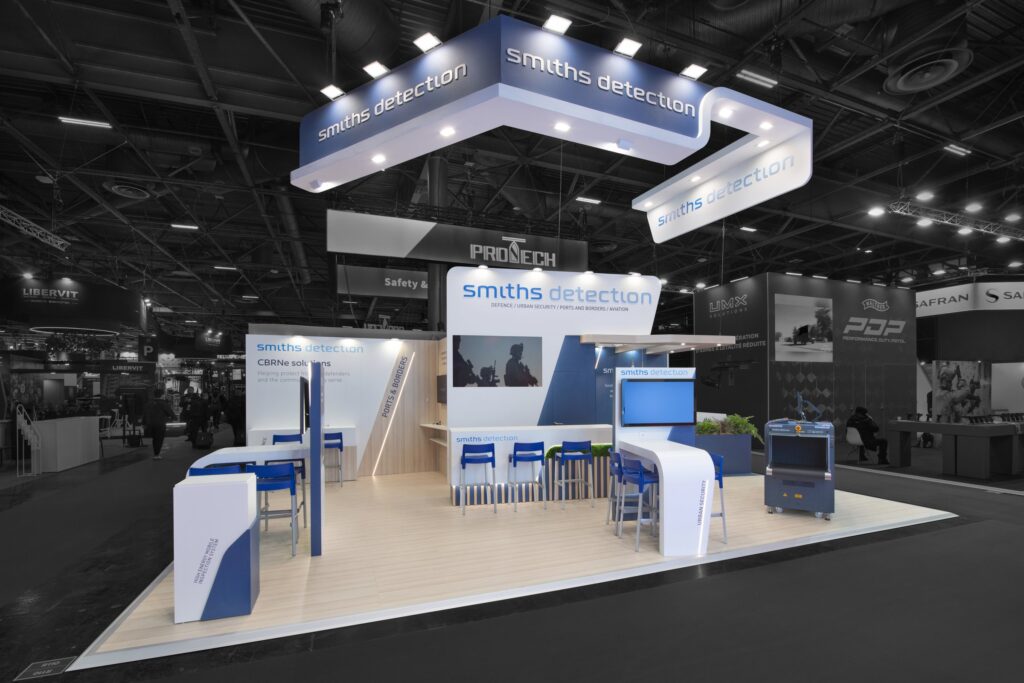
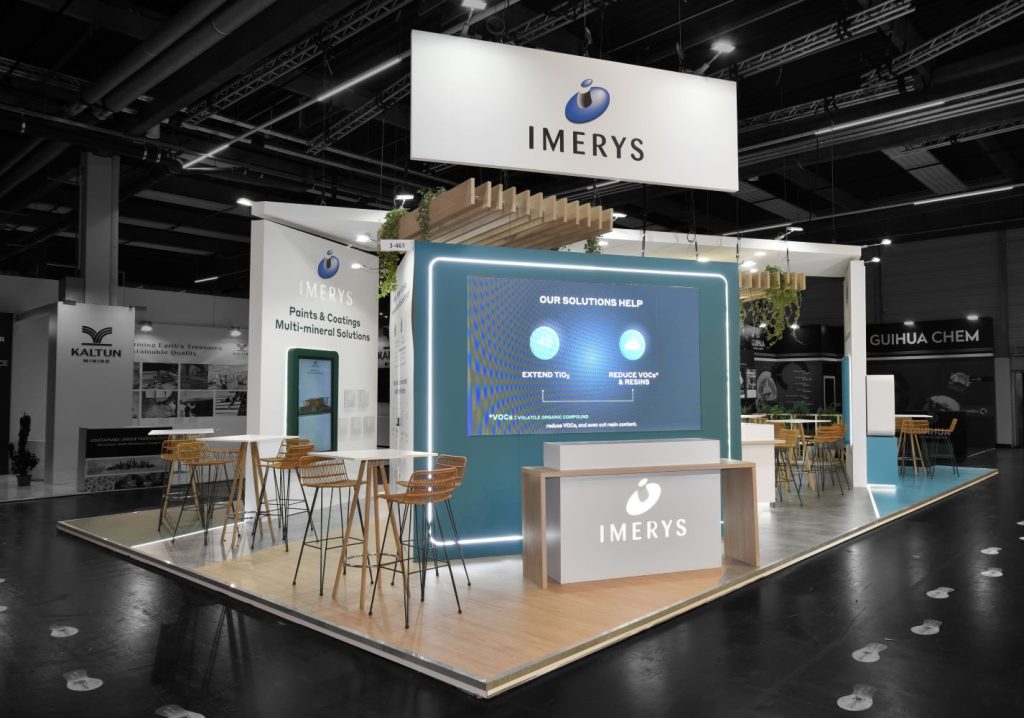
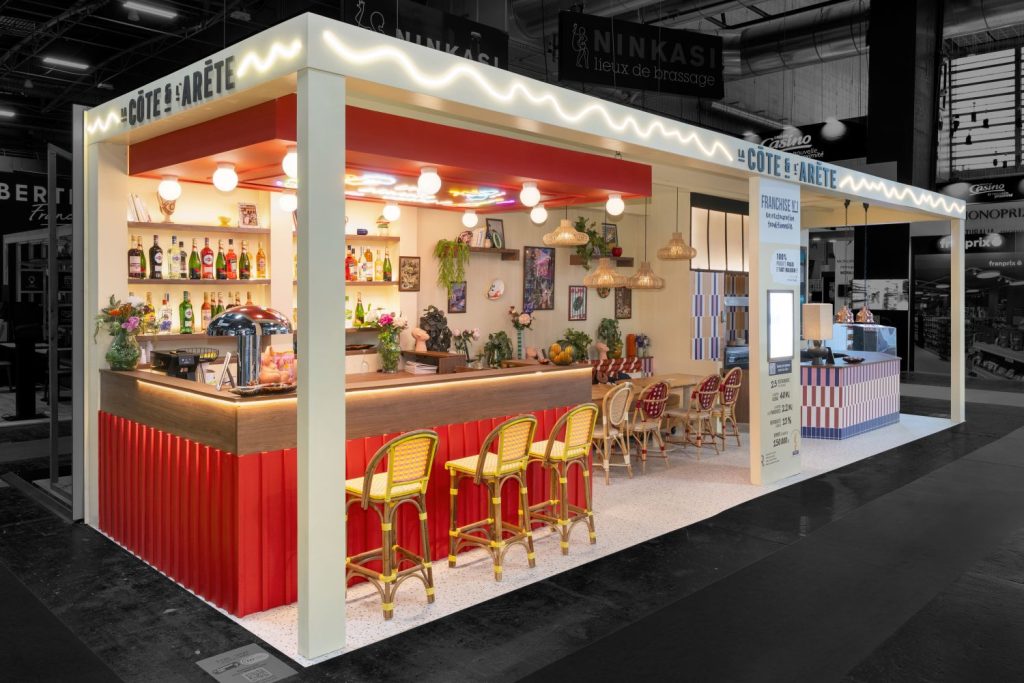
Here are a few examples of booths that may inspire you to build your success at your next trade show
Evaluating the success of your booth at a trade show
How long after the trade show should I calculate my final ROI?
In B2B, the sales cycle can be long.
It is advisable to conduct an initial assessment (D+7) of lead volume and traffic, followed by interim assessments at 3, 6, and 12 months to calculate the actual revenue generated.
What expenses should be included in the calculation of the overall budget for the trade show?
To get an accurate ROI, you need to include everything:
the rental of the space,
the design and manufacture of the booth (R2 Stand),
technical costs (electricity, Wi-Fi),
logistics (transport, assembly),
as well as your team’s living expenses (hotel, meals, travel)
and the communications budget (goodies, brochures).
How can I improve my post-trade show conversion rate?
Responsiveness is key. A lead contacted within 48 hours of the trade show is twice as likely to convert.
Prepare your email sequences (nurturing) before the event even begins to automate follow-ups as soon as the doors close.
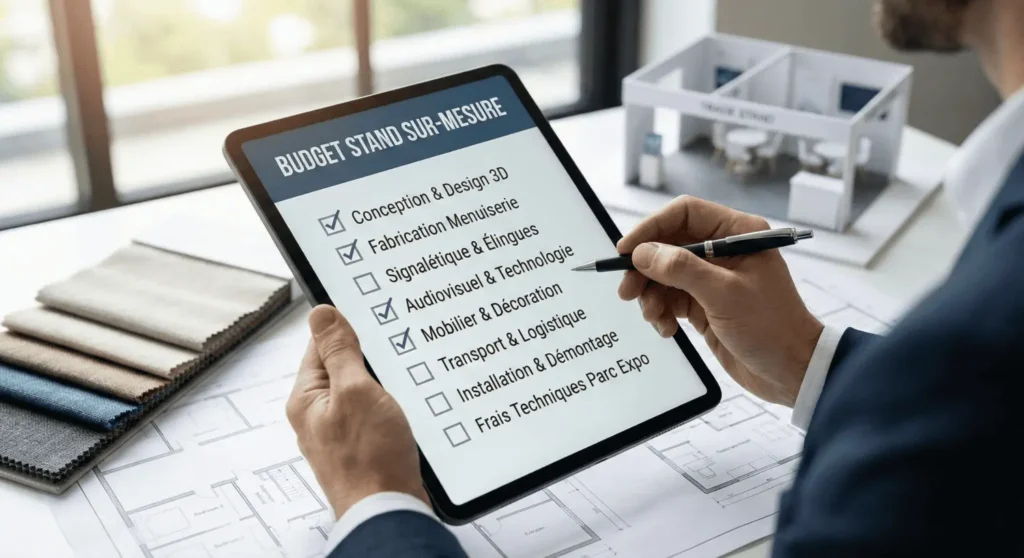
How much does it cost to create a custom-made booth? The budget guide SOMMAIRE Temps de lecture : Participating in a trade show is an exceptional growth driver, but it is also a major investment. When drafting the specifications, a
In order for an exhibition design agency like R2 Stand to offer you a “wow” project that is relevant and profitable, it needs high-quality raw material: the brief (or specifications). An incomplete brief leads to unnecessary back-and-forth, creative disappointment, and
Participating in a trade show represents a significant strategic and financial investment for a company. For this event to be profitable (ROI), simple visibility is no longer enough: the number one goal is to generate qualified leads. As an expert
Pour offrir les meilleures expériences, nous utilisons des technologies telles que les cookies pour stocker et/ou accéder aux informations des appareils. Le fait de consentir à ces technologies nous permettra de traiter des données telles que le comportement de navigation ou les ID uniques sur ce site. Le fait de ne pas consentir ou de retirer son consentement peut avoir un effet négatif sur certaines caractéristiques et fonctions.
Fonctionnel
Always active
Le stockage ou l’accès technique est strictement nécessaire dans la finalité d’intérêt légitime de permettre l’utilisation d’un service spécifique explicitement demandé par l’abonné ou l’utilisateur, ou dans le seul but d’effectuer la transmission d’une communication sur un réseau de communications électroniques.
Préférences
Le stockage ou l’accès technique est nécessaire dans la finalité d’intérêt légitime de stocker des préférences qui ne sont pas demandées par l’abonné ou l’utilisateur.
Statistiques
Le stockage ou l’accès technique qui est utilisé exclusivement à des fins statistiques.Le stockage ou l’accès technique qui est utilisé exclusivement dans des finalités statistiques anonymes. En l’absence d’une assignation à comparaître, d’une conformité volontaire de la part de votre fournisseur d’accès à internet ou d’enregistrements supplémentaires provenant d’une tierce partie, les informations stockées ou extraites à cette seule fin ne peuvent généralement pas être utilisées pour vous identifier.
Marketing
Le stockage ou l’accès technique est nécessaire pour créer des profils d’utilisateurs afin d’envoyer des publicités, ou pour suivre l’utilisateur sur un site web ou sur plusieurs sites web ayant des finalités marketing similaires.