Custom-Made Eco-Friendly Booth: 7 Practical Tips for Your Next Trade Show
SOMMAIRE
Temps de lecture :
Designing an eco-friendly booth for a trade show is possible without sacrificing visual impact or doubling the budget. In France, trade events account for 1% of national greenhouse gas emissions (ADEME, 2023). Transportation accounts for 84% of a national event’s carbon footprint. Each participant generates an average of nearly 2 kg of waste per day.
This is no small matter for an industry that often presents itself as a showcase for innovation.
The tools for change are available. What we’ve observed at R2 Stand while working with exhibitors across a wide range of industries is that a few well-targeted decisions make a real and measurable difference.
Here are 7 steps you can take for your next project.
7 Steps to Designing an Eco-Friendly and Effective Trade Show Booth
1. Choose a reusable structure
This is the action that has the greatest impact.
A booth built for a single trade show, dismantled and discarded after three days of exhibition, represents a considerable waste of materials and money. The modular approach completely reverses this model: the same structural elements adapt to different floor plans, reconfigure according to the trade show’s layout, and can be used for several years.
The hybrid and modular design allows for the development of flexible and adaptable structures that can be dismantled and reconfigured for different events without compromising quality. It eliminates the need to build an entirely new booth for each trade show. The modules are generally lightweight and easy to assemble, which reduces transportation costs.
The benefit isn’t just environmental. Over the course of several trade shows throughout the year, the payback on a high-quality modular booth is significantly more favorable than that of a series of disposable booths. It’s an investment, not a recurring expense.
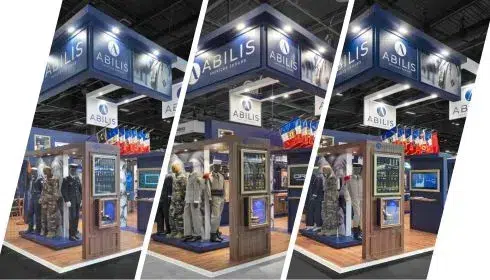
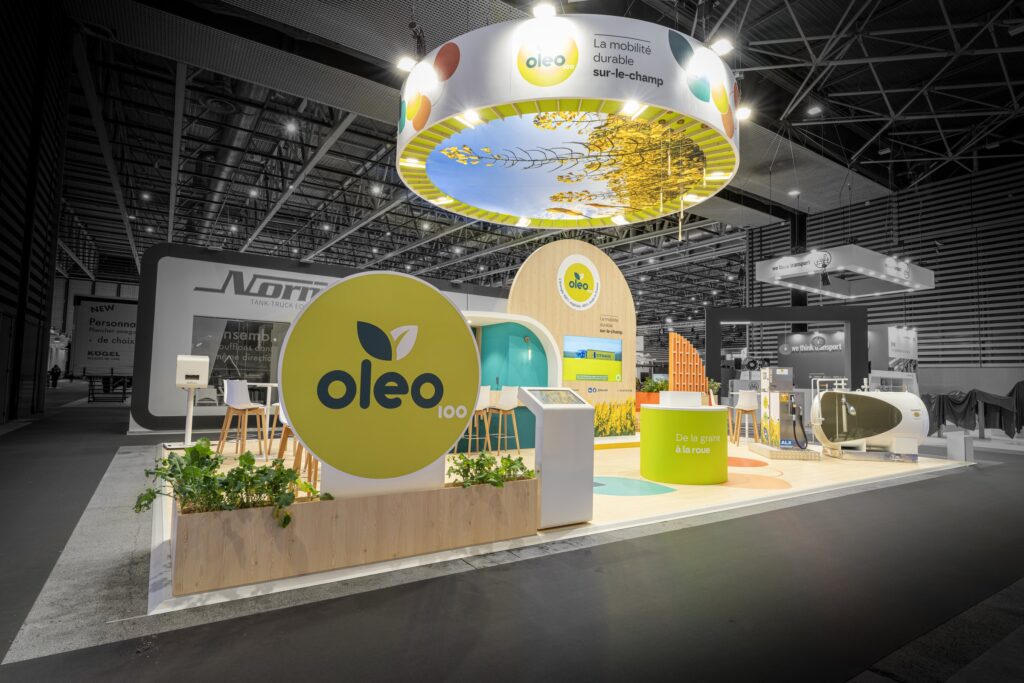
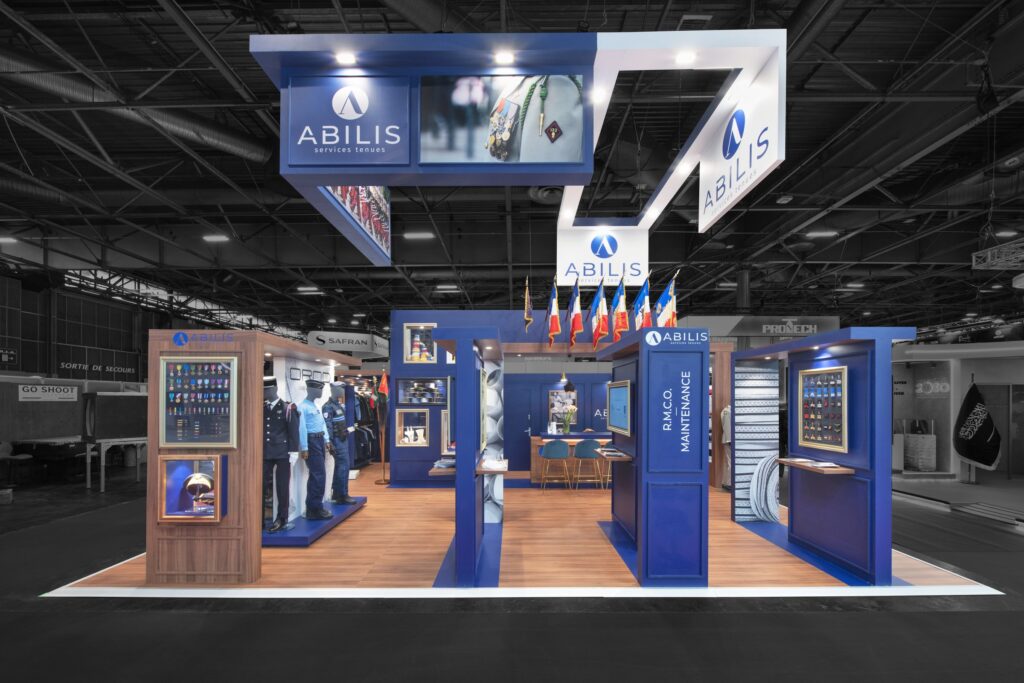
Spot the Difference: An example of a booth that has been set up multiple times… 1 booth, multiple trade shows: a guaranteed commitment to environmental responsibility
⚠️ A custom-made booth doesn’t have to be a one-time use! On average, the custom-made booths created by R2 Stand can be reused four times and can be fully adapted to the layout and space of each trade show.
2. Choosing FSC- and PEFC-certified materials: what an exhibitor should require
Wood, aluminum, textiles… the materials used for an exhibition booth have a source, a manufacturing carbon footprint, and an end-of-life. Addressing these three aspects is already a significant step.
For wood, FSC (Forest Stewardship Council) or PEFC certification is the minimum you should require from your exhibition design agency. These labels guarantee that the wood comes from sustainably managed forests, according to strict ecological, social, and economic criteria.
For panels, avoid non-recyclable composite materials in favor of honeycomb cardboard, recycled polypropylene, or panels made from natural fibers. For printing, eco-friendly water-based or UV inks are a better alternative to chemical solvents.
One point that is often overlooked: the most eco-friendly material is the one that isn’t produced. The most impactful approach isn’t just about choosing the right materials, but about designing a fully reusable system.
💡R2 Stand is certified by numerous CSR and eco-friendly labels: FSC, PEFC, ISO 20121, Diag Decarbon’action, climeet, ecovadis, Valdelia, and muto.
3. Transportation and Local Manufacturing: How to Reduce Your Booth’s Carbon Footprint
Transportation is vastly underestimated in a trade show’s carbon footprint. According to a study by the University of Fribourg (2023), each visitor generates an average of 0.5 to 1.5 tons of CO2 equivalent during a three-day conference. For exhibitors, transporting a bulky exhibition booth over several hundred kilometers weighs heavily on this balance sheet.
Working with a local or regional exhibition booth manufacturer automatically reduces these emissions.
💡 R2 Stand works with a network of partners throughout France and internationally to limit the impact of transportation in the production of your custom-made booth. Our office in Lyon and our office in Paris cover the entire country.
4. LED lighting at the booth: 80% reduction in electricity consumption
This is probably the simplest measure to implement, and it has a direct and immediate impact on your booth’s electricity consumption.
LED lighting consumes up to 80% less energy than traditional light bulbs (ADEME) and has a significantly longer lifespan. At a 3- or 4-day trade show with opening hours of 8 to 10 hours per day, the difference in energy consumption is significant.
Thousands of brochures are handed out at a trade show. Half of them end up in visitors’ bags and in the trash by the end of the day. This is a classic example of event waste.
The solution isn’t to abandon all visual communication at your booth. It’s to consider what’s truly useful in print form and shift the rest to digital.
A well-placed QR code directs visitors to your catalog, website, or quote request page. A touchscreen allows for a more comprehensive product presentation than a brochure, without recurring printing costs.
As a rough estimate: an event with 5,000 attendees generates 2.5 tons of waste and 500 kg of paper (source: ADEME, Bilan Carbone Événements, 2022).
6. Rent plant decorations instead of buying and throwing them away
This is an angle that many exhibitors overlook, and that’s a mistake. Plants have become an essential part of booth design: they add warmth, help structure the space, and enhance visitor comfort.
The problem is that in the vast majority of cases, plants, shrubs, and floral arrangements purchased for a trade show end up abandoned in the aisles during dismantling, or thrown away outright. They have zero life after the show.
Renting plant decorations solves this exact problem. Specialized service providers deliver the plants before the trade show, install them, pick them up after dismantling, and either replant them or put them back into the rental pool for the next event. For trade show booths, renting plant displays is an effective, hassle-free solution: delivery, installation, and removal of the plant arrangements are all handled.
An important detail not to overlook when choosing plants: cut flowers and exotic plants can have significant environmental impacts related to pesticides, CO2 emissions from greenhouse heating, transportation, and cold storage.
The best option is to choose plants and flowers grown in France and rented locally.
In practice, this covers a wide range of solutions: green planters to delineate reception areas, potted trees and shrubs to add height, living walls to adorn the back of a booth, or even arrangements of preserved plants that require no watering or maintenance during the trade show. The plant decor can be as minimalist as a single large specimen placed in the center of the booth, or as elaborate as planters strategically placed to define the space or mark a path.
In addition to the environmental aspect, it serves as a selling point. A booth adorned with live plants immediately conveys your commitment to quality and attention to detail. And visitors notice it.
7. Plan for the end of the booth’s life cycle even before it is built
This is the most overlooked aspect, and it determines everything else.
An eco-friendly booth designed to be easily dismantled, with parts that can be replaced individually, stored without damage, and resold or taken back at the end of its life: this is fundamentally different from a booth assembled with glue and panels that are difficult to separate.
Two criteria to insist on during the design phase:
Modularity: blocks that can be rearranged differently depending on the floor space at the next trade show
Durability: materials and finishes that withstand the cycles of assembly, disassembly, storage, and transport
💡 Labels such as Muto help ensure the socially responsible reuse of temporary exhibits.
What a Responsible Approach Really Changes
The eco-friendly booth is no longer a niche market reserved for players in the organic sector or large companies with dedicated CSR teams.
In 2026, exhibition booths are characterized by a convergence of sustainability, immersive technology, modularity, and a visitor-centered experience. Companies are prioritizing eco-friendly solutions, interactive designs, and structures adaptable to various configurations.
This is a structural shift. According to the 2024 Responsible Consumption Barometer by GreenFlex and ADEME, 65% of French people believe that producing differently is no longer enough and that it is necessary to produce less. The buyers visiting your trade shows are among these French consumers.
Designing a responsible booth does not mean sacrificing visual impact or settling for a bland booth. It means making different design choices from the start, with a manufacturer who understands these challenges.
Are you planning a trade show in 2026 or 2027?
At R2 Stand, we help companies design custom-made booths that incorporate sustainability criteria without compromising on design. Every project begins with an assessment of your actual needs: planned trade shows, floor space, frequency of use, and budget.
Request your personalized quoteand let’s explore together how a booth designed for the long term can enhance your trade show presence.
Frequently Asked Questions About Eco-Friendly Booths at Trade Shows
Does an eco-friendly booth cost more than a traditional booth?
Not necessarily. A booth designed from the outset to be reused won’t be significantly more expensive, even the first time it’s used. Overall, reusing all or part of an existing booth significantly reduces costs.
Which certifications guarantee that a booth is truly eco-friendly?
FSC and PEFC certifications for wood materials, ISO 20121 for responsible event management, and Muto for socially responsible reuse are the industry standards in France. R2 Stand holds all of these certifications.
Is it possible to design a custom-made eco-friendly booth?
Yes. Customization and sustainability are not mutually exclusive. At R2 Stand, our custom-made booths are designed from the outset to be reused at least four times, with modular components that can be adapted to the floor space of each trade show.
How can you highlight your booth’s eco-friendliness without resorting to greenwashing?
Keep it factual and precise: list the materials used, their certifications, their expected reuse rate, and your landscaping contractor.
Avoid vague language. If you can prove it, you can communicate it.
Custom-made, modular, or hybrid booths: Which one is right for your trade shows? SOMMAIRE Temps de lecture : You have a trade show coming up in six months. The registration form is signed, and your booth space is reserved. And
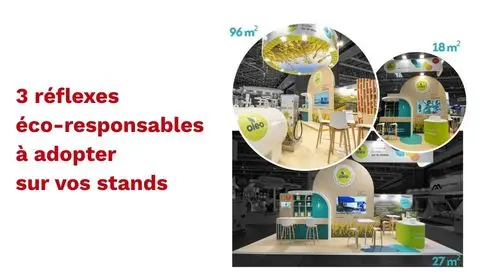
3 eco-friendly habits to adopt at your booths SOMMAIRE Temps de lecture : What if your booth became a showcase for your commitments? A trade show typically lasts 3, 4, or 5 days. But behind those few days lie weeks
How much does it cost to create a custom-made booth? The budget guide SOMMAIRE Temps de lecture : Participating in a trade show is an exceptional growth driver, but it is also a major investment. When drafting the specifications, a
Pour offrir les meilleures expériences, nous utilisons des technologies telles que les cookies pour stocker et/ou accéder aux informations des appareils. Le fait de consentir à ces technologies nous permettra de traiter des données telles que le comportement de navigation ou les ID uniques sur ce site. Le fait de ne pas consentir ou de retirer son consentement peut avoir un effet négatif sur certaines caractéristiques et fonctions.
Fonctionnel
Always active
Le stockage ou l’accès technique est strictement nécessaire dans la finalité d’intérêt légitime de permettre l’utilisation d’un service spécifique explicitement demandé par l’abonné ou l’utilisateur, ou dans le seul but d’effectuer la transmission d’une communication sur un réseau de communications électroniques.
Préférences
Le stockage ou l’accès technique est nécessaire dans la finalité d’intérêt légitime de stocker des préférences qui ne sont pas demandées par l’abonné ou l’utilisateur.
Statistiques
Le stockage ou l’accès technique qui est utilisé exclusivement à des fins statistiques.Le stockage ou l’accès technique qui est utilisé exclusivement dans des finalités statistiques anonymes. En l’absence d’une assignation à comparaître, d’une conformité volontaire de la part de votre fournisseur d’accès à internet ou d’enregistrements supplémentaires provenant d’une tierce partie, les informations stockées ou extraites à cette seule fin ne peuvent généralement pas être utilisées pour vous identifier.
Marketing
Le stockage ou l’accès technique est nécessaire pour créer des profils d’utilisateurs afin d’envoyer des publicités, ou pour suivre l’utilisateur sur un site web ou sur plusieurs sites web ayant des finalités marketing similaires.