Reading time:
In 2024, 318 million visitors attended trade shows worldwide, with 4.7 million exhibiting companies (UFI, Global Exhibition Industry Statistics, May 2025). The market has returned to pre-pandemic levels. So has competition among exhibitors.
Booth design at trade shows is evolving rapidly. What worked in 2022 may now go unnoticed in an aisle saturated with visual stimuli.
Here are the 7 major trends we’re seeing at trade shows in 2026, and how they’re concretely changing the way we design a high-performing booth.
The eco-friendly booth is no longer just a marketing pitch. It’s an environmental imperative that’s becoming a competitive advantage.
Trade show organizers are increasingly incorporating CSR criteria into their specifications, and some major European trade shows now make the allocation of booth spaces contingent on environmental commitments.
Bio-based materials (bamboo, PEFC-certified wood, recycled panels) and structures designed to be reused multiple times reduce the total cost of a booth over the course of 3 to 5 events.
How this changes the design process: Each module is designed from the outset to be disassembled, stored, and reused with minimal remanufacturing.
Components that aren’t returned to inventory are sent to recycling or donation programs; some exhibition design agencies, such as R2 Stand, work with organizations that repurpose materials or structures for other uses. By default, nothing ends up in the trash.
Modularity has long been a part of booth design. What’s changing in 2026 is the sophistication of the assembly systems.
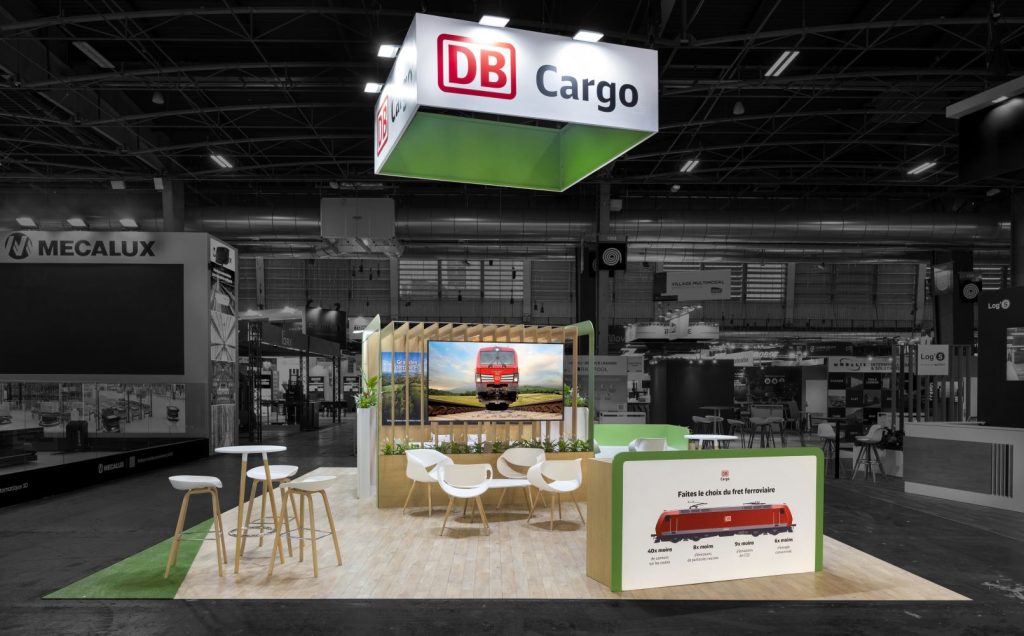
The new modular booth systems no longer resemble the aluminum grids of the 2010s. The profiles have become slimmer, the connectors more precise, and the finishes higher quality. A single set of modules can be used to configure a 12 m² booth at a regional trade show and a 40 m² booth at an international trade show, with a consistent visual identity in both cases.
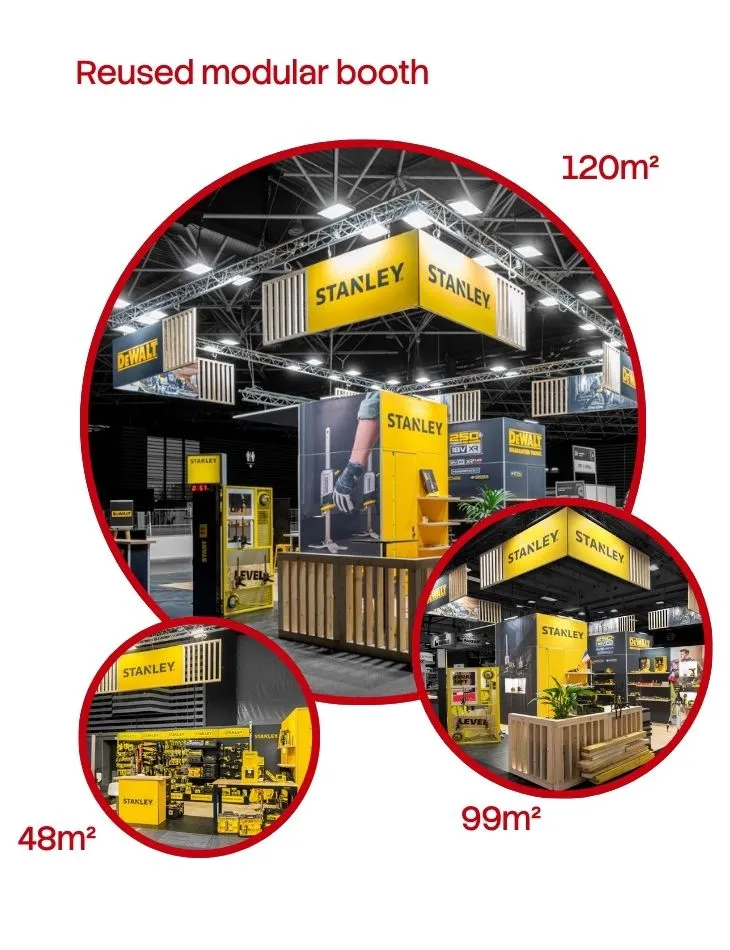
The challenge for a company that participates in 3 or 4 trade shows a year is clear: to design a scalable basic structure rather than starting from scratch each time.
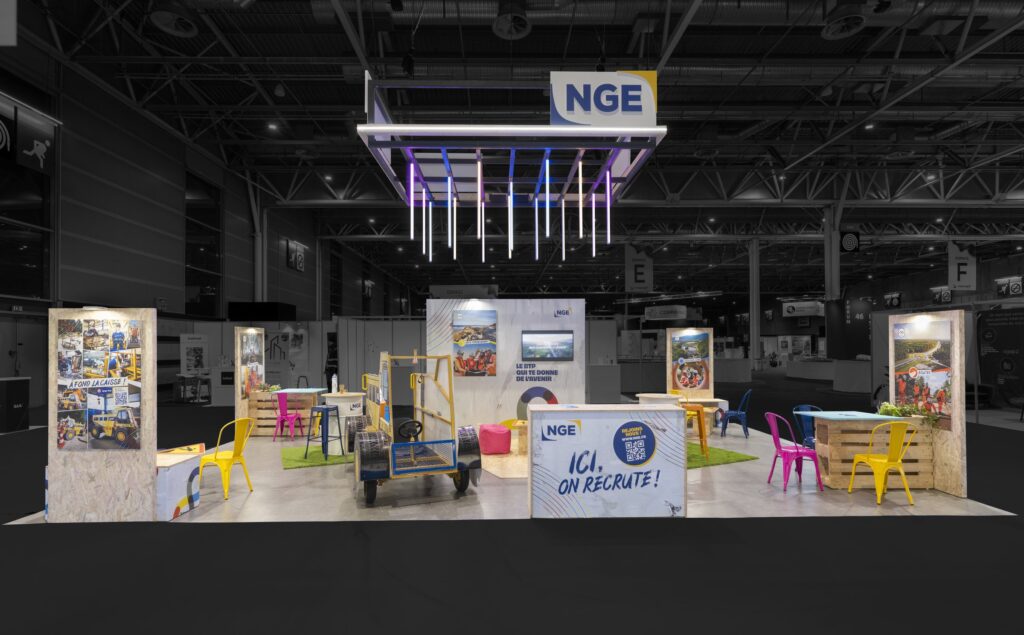
At R2 Stand, we offer hybrid booths: unique, custom-made, reusable elements combined with modular elements.
→ To learn more about hybrid booths, please feel free to contact us
A trade show visitor decides whether to stop or keep walking in just a few seconds. What’s visible from a distance, what moves, what catches the eye: today, digital technology is what does the job.
LED video walls have become the go-to tool for capturing attention in a crowded aisle. A booth backdrop made of high-brightness LED panels displays dynamic content visible from 20 meters away, with no glare and no bezels. The visual impact is immediate. For booths of 20 m² and larger, this is now the most cost-effective solution for creating a strong presence.
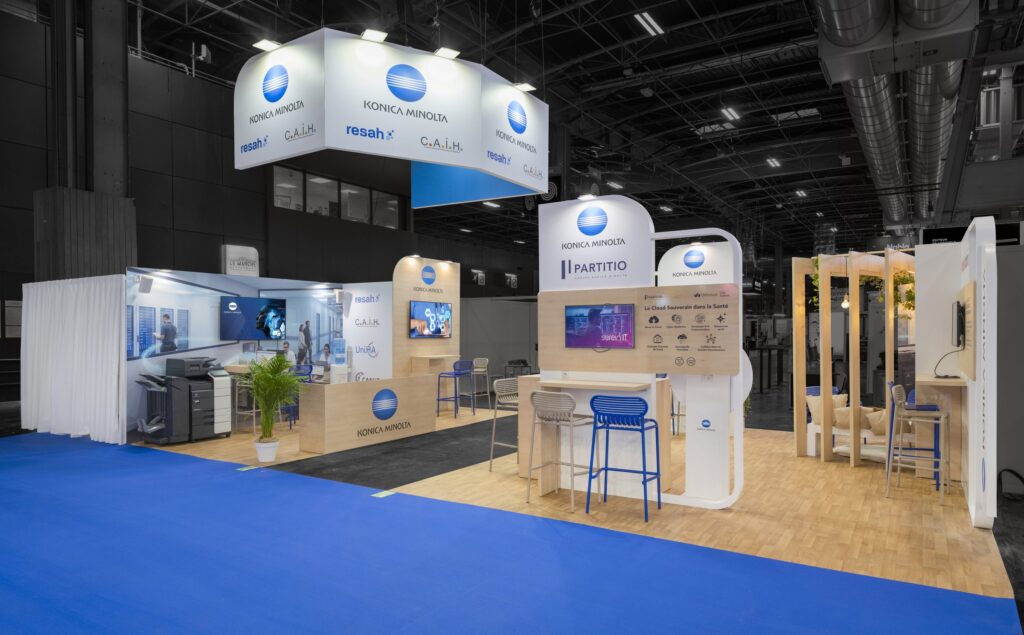
Holograms and virtual reality make it possible to showcase items that cannot be transported. An 8-metric-ton industrial machine, a building under construction, or a product that does not yet exist in physical form: holographic 3D visualization or VR headsets make these demonstrations possible. This is a particularly powerful tool for the industrial sector, the real estate industry, and companies whose products are difficult to understand without context.
Interactive kiosks serve a different purpose: they engage visitors in a specific action. Configuring a product, generating a quote, browsing a catalog, or providing contact information in exchange for content. A well-designed kiosk transforms a passive visitor into an active prospect and captures their data directly into the CRM.
→ Learn how to generate leads at a trade show
There has been a significant increase in exhibitor and visitor satisfaction, which can be partly attributed to the improved quality of the experiences offered at booths, with interactive content being a key factor (UFI, Global Exhibition Industry Statistics, May 2025).
In a trade show aisle, visitors notice the lighting before they read anything else.
A well-lit, stylish booth catches the eye from 15 meters away. A booth with flat or insufficient lighting blends into the general surroundings of the hall.
LEDs with variable color temperatures now make it possible to adjust the lighting ambiance according to the time of day or the type of product being showcased.
Five years ago, this flexibility was reserved for large-scale events. It is now available for standard-sized exhibition booths.
A booth is not a display case. It’s a living space that someone will walk through in 30 seconds if nothing catches their eye, or in which they’ll stay for 10 minutes if it’s well designed.
Booth design is evolving toward a visitor journey approach borrowed from commercial architecture and retail.
Before drawing anything, the questions to ask are: Where do visitors enter? What is the first object or message a visitor sees? Where do we want them to go next? Where does the sales conversation take place?
Clear zoning (demonstration area, discussion area, information area) improves conversion rates: a space where visitors instinctively know where to go and where to stop generates more qualified leads than an open booth with no apparent structure.
There’s a difference between a booth that simply displays a brand’s colors and a booth that embodies that brand.
A booth that reflects your brand’s image ensures consistency across every surface: the texture of the materials, the choice of typefaces on the structures, the scent if the brand has a signature fragrance, and background music if the setting allows it.
This is the least visible trend, but likely the most strategic.
A booth that doesn’t track anything is a booth for which you can’t prove the return on investment. And an unproven ROI is a budget that’s hard to defend during the next budget review.
Measurement tools integrated into the booth are accessible and inexpensive: foot traffic sensors to count visitors and measure dwell time, tracked QR codes on printed materials, and lead forms captured on digital kiosks.
This data allows you to calculate precise trade show KPIs: number of visitors, booth entry rate, average visit duration, and leads generated by source.
At the level of a single trade show appearance, these figures allow you to adjust the design for the next event. Over the course of three or four appearances, they build a database of what actually works for your brand, in your industry, and with your target audience.
→ Learn more about measuring trade show performance
They all require planning the booth earlier in the process and working with an exhibition design agency that understands the business challenges—not just the manufacturing constraints.
A custom-made booth built according to these principles isn’t necessarily more expensive. It’s priced differently: more upfront planning, fewer reworks later on, and better results at the trade show.
At R2 Stand, we’ve been designing and building custom-made, modular, and hybrid booths for over 15 years in France and around the world.
If you’re planning to exhibit and want a booth that really delivers results, request a personalized quote.
FAQ
The cost of a custom-made booth varies depending on its size, materials, and built-in equipment. Over the course of multiple events, a reusable booth is more cost-effective than one that is rebuilt each time.
→ Check out the complete guide, “How Much Does a Custom-Made Booth Cost?”
For a custom-made booth, you should generally allow 6 to 10 weeks from the initial briefing to delivery. The shorter the lead time, the more limited the customization options. Placing your order 4 months in advance gives you the necessary leeway for an optimized design.
The most reliable metrics are the number of qualified leads generated, the cost per lead compared to other acquisition channels, and the conversion rate of trade show leads at 3 and 6 months. Trade show KPIs require data from multiple events to become statistically significant.
→ Discover the essential KPIs for measuring the performance of your trade show presence
How R2 Stand Rose to the Enormous Challenge of the 2026 Esports World Cup in Paris at Porte de Versailles TABLE OF CONTENTS Reading time: The Esports World Cup (EWC 2026) is one of the world’s largest competitive video game
Transportation, Setup, SafetyThe Exhibitor’s Guide SUMMARY Reading time: A trade show requires months of preparation. The booth design is approved, the staff schedule is finalized, the promotional items are ordered… And then, just a few days before the show opens,
Hybrid Booth: The Balance Between Custom-Made Booth and Modularity SUMMARY Reading time: A hybrid booth is a solution that combines a modular booth with custom-made elements focused on your brand’s most visible touchpoints: signage, reception desk, and display furniture. The